Residence, visas, naturalization, and work permits are not different names for the same procedure. Each has a competent authority, requirements, and steps that may vary by category and by the person’s circumstances. This guide explains, in general terms, the role of Panama’s National Immigration Service (SNM) and the legal framework that guides its work.
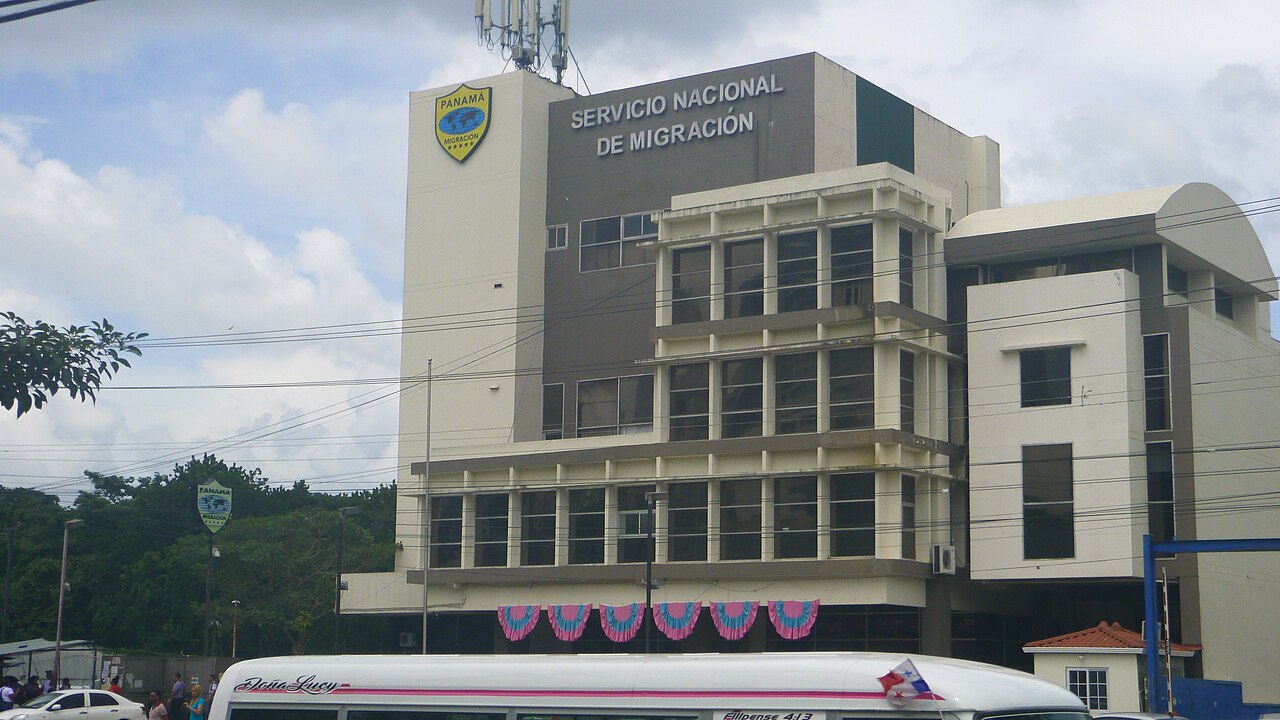
Cover photo: the National Immigration Service headquarters on Ricardo J. Alfaro Avenue. Photograph by MagicOneV, 2018, published on Wikimedia Commons under the Creative Commons Attribution-ShareAlike 4.0 license. The original file is preserved; the page layout may crop its display.
What the National Immigration Service does
Decree Law No. 3 of 2008 established the SNM as a public-safety and administrative-management institution responsible for carrying out immigration policy, supervising and controlling migration, and providing services to foreign nationals as permitted by law. Article 5 provides that the Service operates continuously throughout the country and that its officers are appointed by the Director General under the Immigration Career rules and assigned to offices or posts according to their specialties.
Continuous nationwide operations do not necessarily mean that every public-service counter is open 24 hours a day. Office hours, appointments, online channels, and available services should be confirmed with the relevant office or official platform.
When the SNM’s official authorities page was checked on October 10, 2026, Lic. Roger Mojica Rivera was listed as Director General. Appointments can change, so check the institutional page before addressing documents to an authority.
How a residence application generally proceeds
There is no single procedure that applies to every visa or residence category. As a general guide, an application may move through these stages:
- Identify the appropriate category. The possible route is assessed based on nationality, family ties, activity, investment, or other circumstances covered by the rules. A category’s general description does not replace checking its current requirements.
- Prepare the file. Forms, certificates, identity documents, and other applicable evidence are gathered. Validity periods, notarization, apostilles, translations, and filing formats depend on the specific documents and process.
- File through the available channel. Depending on the procedure, this may involve an online platform, an appointment, an SNM office, or a diplomatic or consular mission. Keep proof of filing and monitor notices.
- Respond to review or requests to correct the file. The authority may verify information or ask for missing or corrected materials. Do not ignore a request: follow its deadline and instructions.
- Wait for the competent authority’s decision. Filing documents does not automatically guarantee approval. When a decision is issued, review its conditions, validity, and next steps, including identification or renewal requirements.
These stages are a general map, not a checklist of requirements or a guaranteed timeline. Confirm the specific route through the SNM’s official channels for the relevant category.
Residence and work authorization are separate matters
The SNM handles immigration matters such as visas and residence categories. The Ministry of Labor and Workforce Development (MITRADEL), however, is the authority that grants migrant workers’ authorization to work under labor rules. Residence and work authorization may be related or coordinated in certain situations, but residence status alone should not be treated as permission to work. Confirm which authorization applies and which agency issues it.
The National Immigration Service’s 22 functions
Article 6 of Decree Law No. 3 lists the SNM’s institutional functions. The following plain-language summaries are not a list of steps every applicant must complete, nor do they mean that any individual officer can decide every matter:
- Carry out the State’s immigration policy and seek compliance with current immigration laws.
- Organize and provide immigration services to foreign nationals, record and oversee those services, and monitor lawful stay.
- Control and record nationals’ and foreign nationals’ entries into and exits from the country.
- Decide, within constitutional and legal limits, on foreign nationals’ entry or stay and order the deportation, expulsion, or return measures provided by law.
- Approve or deny requests to change immigration category in Panama through a reasoned resolution.
- Approve or deny requests for immigration categories processed through embassies or consulates.
- Cancel non-resident, temporary-resident, or permanent-resident permits by reasoned resolution and as allowed by law.
- Receive and decide non-resident visa applications.
- Issue identification documents to people Panama has recognized as refugees, asylees, stateless persons, or persons under temporary humanitarian protection.
- Issue safe-conduct documents for foreign nationals whose countries have no diplomatic or consular representation in Panama.
- Comply with and implement international migration agreements ratified by Panama.
- Administer repatriation and guarantee deposits paid into the Migration Trust Fund, and return them when legally appropriate.
- Administer the institution’s Special Fund for Human Resource Development.
- Establish internal procedures, protocols, and administrative rules for institutional management.
- Conduct immigration checks on passengers using local or international public or private transportation at airports, borders, seaports, river ports, and other authorized locations nationwide.
- Inspect workplaces and public-access locations when there are indications of immigration irregularities.
- Share information and cooperate with national agencies, foreign counterparts, and international organizations to combat human trafficking, migrant smuggling, transnational organized crime, terrorism, illegal arms and explosives trafficking, the unlawful diversion of dual-use goods, and related activities.
- Apprehend, keep in custody, or detain foreign nationals who violate immigration law, in the cases and on the terms provided by law.
- Investigate possible immigration-law violations and assist competent authorities with related criminal investigations.
- Exercise the jurisdiction to enforce collection of debts where the law grants that authority.
- Apply administrative sanctions for violations of the Decree Law and its regulations.
- Carry out any other functions assigned by law or regulation.
The book Residencias y permisos de trabajo: compendio de normas migratorias en Panamá is listed in the bibliographic catalogue as a 2023 publication compiled by José Antonio Carrillo Pujol. Because laws and procedures can change, this guide checks the functions against the text published in the Official Gazette and recommends verifying later provisions as well.
What to confirm before taking action
- The exact category and current rules that apply to your circumstances.
- The filing channel, documents, and formalities required for that process.
- Any deadline stated in an official notice or decision.
- Whether you also need a work authorization from MITRADEL.
- The latest official source, since forms, channels, and administrative procedures may change.
This article provides general information and is not a substitute for an individual assessment or an official decision. Contact Attorney Alicia Fasta if you need to discuss which route may fit your circumstances.